In my previous school district, I was the only teacher teaching a physics course with set, district-wide learning outcomes. These same outcomes were also taught in physics classrooms at the other high school in our district. But at our school, I was one of the 2 physics teachers. The other teacher taught the AP-level physics courses. So, in many ways, I had opportunities to incorporate strategies I believed were best for learners and that I found worked best for them without being seen as out of alignment with anyone in our building. My amazing friend and one of my teaching philosophy goddesses, Katie Novak, stated the following misconception about alignment: All teachers must deliver instruction in the exact same way. True alignment, she says, is about shared goals, rigor, and outcomes. Thank you, Katie! Katie has taught me to truly believe that learner variability is the rule, not the exception. I encourage you to take 10 minutes to listen to Katie Novak explain it in the ...
An ePortfolio is a chance for a student to make the argument that they have mastered all the objectives in a course.
In the climax of Oliver Stone’s film JFK, Jim Garrison sums up his entire case by providing pieces of evidence in the hope of finding Clay Shaw guilty of conspiracy to assassinate President Kennedy. Although the accuracy of many of the facts in the movie have been brought into question, there is no doubt that the entire closing argument sequence of the film is a masterclass in editing and screenwriting. Stone uses multiple film stocks to create the sense of cinema verite alongside of stocks that denote a subjective perspective. If you have never seen it or haven’t seen the section in a while, seek it out. I could probably teach an entire semester course on it.
My students use Google Sites to create their ePortfolios. Our district uses Google Apps for Education. So, all student projects are stored on their Google Drive. Google Sites allows for simple embedding of any files from Drive directly into a web page. This takes all the guesswork out of uploading files and formatting them for embedding. I am able to create a template to get students started. As we go, students learn the basics of creating and editing their own portfolio pages. There are different levels of customization from novice (changing themes) to advanced (changing overall layout of web page and site navigation). This provides for a wide level of differentiation among different student groups.
Rather than provide a length explanation of each portfolio section, I've decided to let some student examples speak for themselves.
The Home Page
This is where the student introduces herself, states her learning goal for the class, and states her personal mission statement.


Identify Objectives


Now, I have students treat the objective like a prompt to be broken down (bolding verbs and underlining objects). Then, students explain how they met each objective within they unit.


Progress Sheet
The progress sheet is where students keep track of their progress towards objective mastery on formative assessment throughout the unit.


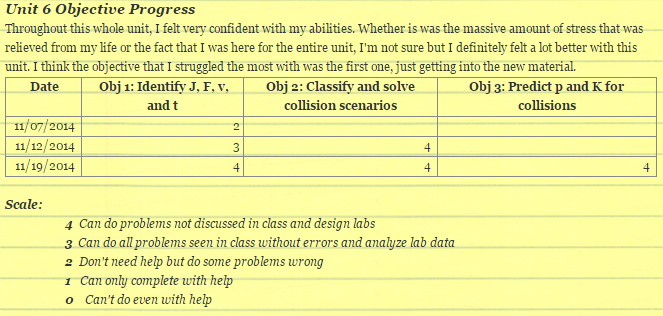
I have now added columns for feedback about the unit with Plus and Delta columns. This is taken from the CCI model. What is CCI?
The progress sheet is where students keep track of their progress towards objective mastery on formative assessment throughout the unit.
I have now added columns for feedback about the unit with Plus and Delta columns. This is taken from the CCI model. What is CCI?


Unit Project


The response to the portfolio process from my students has been nothing but positive. Students state that it is the best representation of their knowledge. They are less stressed than preparing for an exam even if it may be more work. It truly requires them to be reflective about the work they have done in class. Also, it has allowed them to learn how to create a web site a skill many of them never had and didn't think they could learn.
I can't imagine ever going back to a tradition final exam in any of my classes.
O.K. This post is awesome, too! I love the focus on students identifying their own objectives and expressing it in their own language. Some of their objectives and goals are more ambitious and difficult to achieve than we might set for them. Pretty telling when a student says, "...teaches physics in a way that has the ability to capture my attention and keep me involved in the class."
ReplyDelete